Emergency Management News

Wednesday, May 31, 2017

June Climate Data is supplied by @OKmesonet

Periods of Record
Temps#1903-2010
Precip#1903-2012
Snow#1903-2012
# - large gaps in record
Key
* - Record since tied
Highlight = Jun record
All Temps in deg F
All Precip in inches
Sig Prcp Freq = Pct of
days with >= 0.1" precip
Jun. Averages
High Temp93 F
Low Temp67 F
Avg Temp80 F
Precip3.60"
Snow0.0"
1T Avgs: 88/62
Sig Prcp Freq: 24%
Extremes:
High T111 (1998)
Low T48 (1964)
Precip2.87 (1963)
2T Avgs: 88/62
Sig Prcp Freq: 26%
Extremes:
High T111 (1998)
Low T45 (1917)
Precip5.87 (1991)
3T Avgs: 87/63
Sig Prcp Freq: 22%
Extremes:
High T103 (1998)
Low T44 (1919)
Precip3.40 (1949)
4T Avgs: 88/63
Sig Prcp Freq: 21%
Extremes:
High T107 (2008)
Low T49 (1919)
Precip3.38 (1995)
5T Avgs: 89/63
Sig Prcp Freq: 19%
Extremes:
High T106* (1966)
Low T47 (1928)
Precip4.60 (1985)
6T Avgs: 89/63
Sig Prcp Freq: 25%
Extremes:
High T104 (1948)
Low T49 (1998)
Precip3.60 (1941)
7T Avgs: 91/64
Sig Prcp Freq: 17%
Extremes:
High T104 (1984)
Low T48 (1983)
Precip2.00 (1989)
8T Avgs: 92/65
Sig Prcp Freq: 18%
Extremes:
High T110 (1988)
Low T51 (1915)
Precip2.70 (1937)
9T Avgs: 91/65
Sig Prcp Freq: 20%
Extremes:
High T108 (1988)
Low T54 (1996)
Precip3.30 (1979)
10T Avgs: 91/65
Sig Prcp Freq: 18%
Extremes:
High T111 (1958)
Low T51 (1955)
Precip3.15 (1995)
11T Avgs: 91/65
Sig Prcp Freq: 21%
Extremes:
High T108 (1958)
Low T48 (1955)
Precip1.18 (1995)
12T Avgs: 91/66
Sig Prcp Freq: 20%
Extremes:
High T108 (1917)
Low T51 (1903)
Precip1.72 (1982)
13T Avgs: 92/66
Sig Prcp Freq: 18%
Extremes:
High T109 (1998)
Low T50 (1941)
Precip1.95 (1978)
14T Avgs: 92/65
Sig Prcp Freq: 18%
Extremes:
High T113 (1953)
Low T48 (1947)
Precip2.17 (1944)
15T Avgs: 92/66
Sig Prcp Freq: 18%
Extremes:
High T111 (1924)
Low T53* (1947)
Precip1.93 (1928)
16T Avgs: 93/66
Sig Prcp Freq: 16%
Extremes:
High T107 (1925)
Low T50 (1917)
Precip1.26 (1972)
17T Avgs: 93/67
Sig Prcp Freq: 17%
Extremes:
High T111 (1924)
Low T55 (1981)
Precip1.49 (2000)
18T Avgs: 94/68
Sig Prcp Freq: 8%
Extremes:
High T113 (1924)
Low T54 (1945)
Precip0.90 (1982)
19T Avgs: 95/68
Sig Prcp Freq: 16%
Extremes:
High T109 (1998)
Low T58* (1945)
Precip1.56 (2008)
20T Avgs: 95/68
Sig Prcp Freq: 15%
Extremes:
High T109 (1998)
Low T51 (1973)
Precip2.03 (1939)
21T Avgs: 95/68
Sig Prcp Freq: 15%
Extremes:
High T111 (1998)
Low T53 (1903)
Precip2.32 (1958)
22T Avgs: 94/68
Sig Prcp Freq: 17%
Extremes:
High T107 (1969)
Low T56 (1903)
Precip4.17 (1975)
23T Avgs: 94/68
Sig Prcp Freq: 14%
Extremes:
High T105* (1953)
Low T52 (1903)
Precip1.45 (1948)
24T Avgs: 95/68
Sig Prcp Freq: 14%
Extremes:
High T111 (1980)
Low T58* (1957)
Precip2.13 (1946)
25T Avgs: 95/68
Sig Prcp Freq: 12%
Extremes:
High T111 (1980)
Low T52 (1974)
Precip2.21 (1999)
26T Avgs: 95/68
Sig Prcp Freq: 13%
Extremes:
High T111 (1918)
Low T53 (1974)
Precip2.11 (1938)
27T Avgs: 96/69
Sig Prcp Freq: 15%
Extremes:
High T115* (1980)
Low T56* (1958)
Precip1.90 (1997)
28T Avgs: 97/69
Sig Prcp Freq: 14%
Extremes:
High T113 (1980)
Low T55* (1903)
Precip1.86 (2010)
29T Avgs: 95/70
Sig Prcp Freq: 13%
Extremes:
High T110 (1980)
Low T58 (1948)
Precip2.55 (2004)
30T Avgs: 95/70
Sig Prcp Freq: 6%
Extremes:
High T108 (1980)
Low T58* (1924)
Precip3.15 (1987)

Wednesday, May 24, 2017

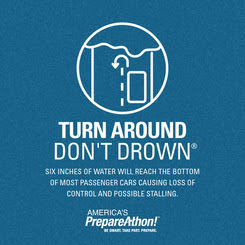
Turn Around Don’t Drown #TADD

Turn Around, Don't Drown InfographicFlooding is the most common natural disaster in the United States, and most flood-related deaths can be prevented if you understand the force and power of rushing flood water. When you see flood waters ahead:Turn Around Don't Drown.

Stay safe by staying out of flood waters before and after the floods or storms have passed.

If you come upon flood water, you may not know how deep the water is or what is in the water that you cannot see including hazardous materials, sharp items or downed power lines. Consider these facts to be flood smart:

·         Just six (6) inches of moving water can knock you down.
·         Just one (1) foot of water can sweep your vehicle off the roadway.
·         If your vehicle is trapped in rapidly moving water, stay in the vehicle.
·         If water is moving at a high velocity and is rapidly rising in the vehicle, exit the vehicle immediately, seek refuge on the roof of the vehicle, and signal for help. 
·         If your vehicle stalls, leave it immediately (unless water is moving at a high velocity) and move to higher ground. Rapidly rising water can engulf the vehicle and its occupants, sweeping them away.

For more information on how to prepare and stay safe download thePrepareathon How to Prepare for a Flood guide.

Tuesday, May 23, 2017

Community Discussion: Sharing Innovative Community Preparedness Ideas


On Wednesday, May 24, the Federal Emergency Management Agency’s (FEMA) Individual and Community Preparedness Division invites you to a webinar showcasing nationwide innovative preparedness efforts. Speakers will share how they developed innovative program ideas to address needs in their communities. This webinar will also feature how you can receive recognition for your preparedness initiatives by providing an overview of the 2017 FEMA Individual and Community Preparedness Awards.

Title: Community Discussion: Sharing Innovative Community Preparedness Ideas
Date: Wednesday, May 24
Time:  2 – 3:00 p.m. EDT
How to Join the Webinar:

We hope to that you will be able to join us on May 24!